

Planning a call to family in New York from London? Scheduling a video chat with Camp New York from the United Kingdom? Understanding what is the time difference between UK and New York helps you connect at the right moment. Nobody wants to wake someone at 3am or miss important office hours.
The time gap between these two major world cities shifts throughout the year. This happens because both regions observe daylight saving time on different schedules. Most of the year, the United Kingdom runs five hours ahead of New York. But during certain weeks, that gap shrinks to just four hours.
This guide breaks down everything you need to know. We cover the standard time difference, explain how daylight saving changes the calculation, and share the best times to reach Camp New York from the UK. By the end, you’ll confidently schedule calls across the Atlantic without second-guessing the hour.
Understanding Time Zones: UK and New York
Time zones create the foundation for calculating differences between cities around the world. The United Kingdom operates on Greenwich Mean Time during winter months and British Summer Time when clocks spring forward. New York follows Eastern Standard Time in winter and Eastern Daylight Time in summer.

Greenwich Mean Time and British Summer Time
Greenwich Mean Time serves as the baseline for measuring time zones globally. Located at zero degrees longitude, Greenwich in London marks the starting point. The UK stays on GMT from late October through late March.
When March arrives, clocks move forward one hour to British Summer Time. This shift gives more daylight during evening hours. BST runs until the final Sunday in October, when clocks fall back to GMT.
Eastern Time Zone in New York
New York sits firmly in the Eastern Time Zone. During standard time months, EST runs five hours behind GMT. The city observes Eastern Standard Time from early November through early March.
Daylight saving time changes the picture. Clocks spring forward in March, shifting New York to EDT. This time zone operates four hours behind GMT but five hours behind BST during overlap periods.
Quick Reference: The United Kingdom uses GMT and BST. New York operates on EST and EDT. Both regions change their clocks twice yearly, but not on the same dates. This creates brief periods where the time difference shifts between four and five hours.
The Standard Five-Hour Time Difference
Most of the year, London time runs exactly five hours ahead of New York time. When your clock shows 2pm in the United Kingdom, New York residents are just starting their workday at 9am. This five-hour gap holds steady during most seasons.

How the Five-Hour Difference Works
The calculation remains simple during standard time periods. Take the current London hour and subtract five to find New York time. Morning in the UK translates to early hours or night in New York. Evening in London means afternoon across the Atlantic.
Here are practical examples that show the pattern:
- 9am in London equals 4am in New York
- 12pm noon in the United Kingdom means 7am in New York
- 6pm London time converts to 1pm New York time
- 11pm in the UK translates to 6pm in New York
| London Time (GMT) | New York Time (EST) | Time of Day |
| 8:00 AM | 3:00 AM | Early Morning |
| 12:00 PM | 7:00 AM | Midday / Morning |
| 3:00 PM | 10:00 AM | Afternoon / Mid-Morning |
| 6:00 PM | 1:00 PM | Evening / Early Afternoon |
| 9:00 PM | 4:00 PM | Night / Late Afternoon |
When the Five-Hour Rule Applies
The five-hour time difference between London and New York dominates most calendar months. From early November through mid-March, both cities observe standard time together. The gap holds firm at five hours during this winter period.
Late March brings changes as daylight saving begins. The five-hour difference continues when both regions shift to summer time simultaneously. From late March through late October, London stays five hours ahead while both observe daylight hours.

Daylight Saving Time and the Four-Hour Gap
Twice each year, the time difference between UK and New York briefly shrinks to four hours. This temporary shift happens because America and Britain change their clocks on different dates. Understanding these transition periods helps avoid scheduling confusion.

Spring Transition Period
March brings the first transition. The United States springs forward earlier than the UK. For roughly two weeks, America operates on daylight time while Britain remains on GMT. During these days, the gap narrows to four hours.
When it’s 2pm in London during this spring window, New York shows 10am instead of the usual 9am. This four-hour difference lasts until the UK switches to British Summer Time on the final Sunday of March.
Autumn Transition Period
October creates the second shift. The United Kingdom falls back to GMT before America returns to standard time. For about one week, Britain moves to winter hours while New York maintains daylight time. The difference again becomes four hours.
These autumn days reverse the spring pattern. The gap stays at four hours until early November when the United States finally changes clocks. Then the standard five-hour difference returns for winter months.
Spring Transition
Mid-March for approximately 2 weeks
- USA switches to daylight time first
- UK remains on GMT temporarily
- Four-hour gap until UK catches up
- Usually occurs second Sunday in March
Autumn Transition
Late October for approximately 1 week
- UK switches to GMT first
- USA remains on daylight time temporarily
- Four-hour gap until USA follows
- Usually occurs last Sunday in October
Important Note: The exact dates for daylight saving changes vary each year. Always verify current time zones when scheduling important calls during March and October. Most smartphones and computers update automatically, but manual calculations need careful checking during transition weeks.
How to Calculate the Time Difference Any Day
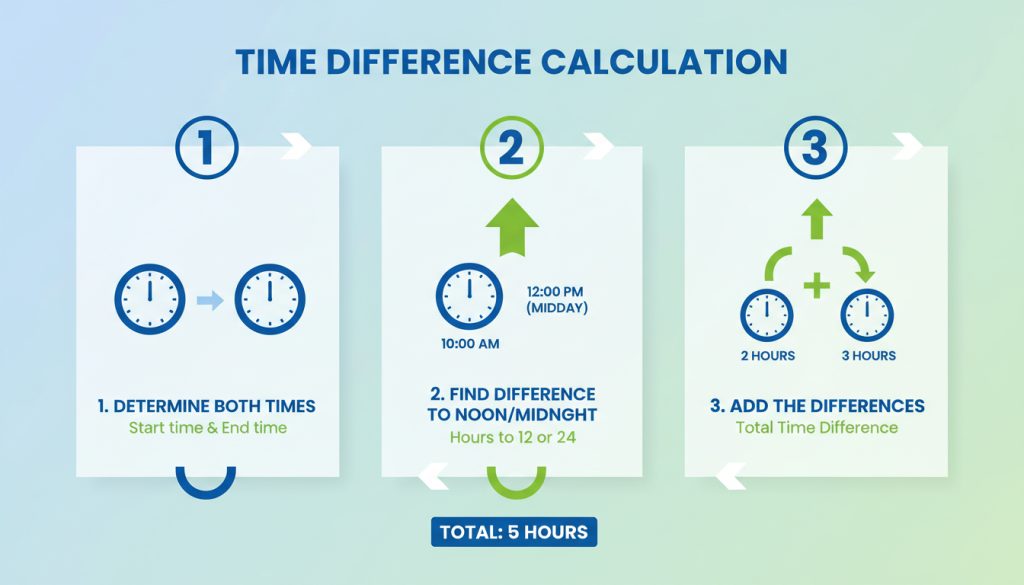
You can quickly figure out New York time from London time using simple mental math. The core principle stays consistent: subtract hours from UK time to find what clocks show in New York. The exact number depends on the current season.
Quick Mental Math Method
Start with your current London time. Most of the year, subtract five hours to get New York time. If your London clock shows 3pm, count back five hours to reach 10am in New York. This works perfectly during standard months.
During brief transition periods, subtract four hours instead. Check the calendar first. If you’re in mid-March or late October, use the four-hour rule. Otherwise, stick with five hours for accurate results.
Step-by-Step Calculation Process
- Check the current month to determine if both regions observe the same time type
- Use five hours for November through mid-March and late March through October
- Use four hours only during the brief transition weeks in spring and autumn
- Subtract the appropriate number from your London time
- Adjust the day if calculation crosses midnight

Handling Midnight Crossover
Evening hours in London sometimes translate to previous-day times in New York. When your UK clock shows 2am on Tuesday, subtracting five hours brings you to 9pm on Monday in New York. The date changes along with the hours.
This matters for scheduling. A Monday evening call from London might reach New York during Monday afternoon. But a very early Tuesday morning London call connects with Monday evening in New York. Always account for date shifts when planning late or early contacts.
Pro Tip: Modern smartphones automatically adjust for time zones. When scheduling a call, check both your local time and the recipient’s time zone in your phone’s world clock feature. This removes guesswork and prevents errors during transition periods.
Best Times to Call Camp New York from the UK
Finding the right window to contact Camp New York from the United Kingdom requires balancing both time zones. You want to call during New York business hours while choosing a UK time that fits your schedule. Certain windows work better than others for international communication.

Optimal Calling Windows
Late afternoon in the United Kingdom offers the sweet spot for reaching camp staff. Between 2pm and 6pm London time, Camp New York operates during their morning and early afternoon hours. This window catches the camp office during active business hours.
When you call at 3pm from the UK, New York time shows 10am. Camp staff are settled into their workday. Morning rush has passed, but afternoon wrap-up hasn’t started. This mid-morning New York slot typically provides the most responsive communication.
| UK Time | New York Time | Recommended For |
| 2:00 PM – 3:00 PM | 9:00 AM – 10:00 AM | General inquiries, enrollment questions |
| 3:00 PM – 5:00 PM | 10:00 AM – 12:00 PM | Detailed discussions, program planning |
| 5:00 PM – 7:00 PM | 12:00 PM – 2:00 PM | Follow-up calls, brief check-ins |
| 7:00 PM – 9:00 PM | 2:00 PM – 4:00 PM | Emergency contacts, urgent matters |
Alternative Contact Methods
Email works perfectly when calling times don’t align. Send messages during UK evening hours, and Camp New York staff receive them fresh each morning. Responses typically arrive by UK afternoon, creating a smooth communication rhythm across time zones.
Many families prefer mixing phone calls with email. Use afternoon phone windows for important discussions. Follow up with email for documentation and detailed questions. This combination respects both time zones while maintaining clear communication throughout the enrollment process.

Tips for Successful International Calls
- Double-check the current time difference before dialing, especially during March and October transitions
- Write down your questions beforehand to make the most of calling windows
- Consider using video calling apps that display both time zones automatically
- Save Camp New York contact details with a note about optimal UK calling hours
- Account for potential wait times during peak camp season inquiries
Real-World Time Conversion Examples
Seeing actual examples helps cement the time difference in your mind. These scenarios show how London times translate to New York hours across different parts of the day. Each example includes practical context for when you might need that specific conversion.

Morning Time Conversions
Early UK mornings reach deep into New York night. When you wake at 7am in London, New York residents are still sleeping at 2am. This makes morning a poor choice for calls. By 10am UK time, New York just hits 5am, still too early for business contacts.
Late UK morning becomes acceptable for urgent matters. At 11am in the United Kingdom, New York clocks show 6am. Some early risers might answer, but standard business hours haven’t started. Wait until UK noon to reliably catch New York morning hours beginning at 7am.
Afternoon and Evening Conversions
UK afternoons provide the best overlap with New York business hours. At 2pm London time, New York offices open their doors at 9am. This zone continues through early UK evening, offering maximum availability across the Atlantic.
As UK evening progresses, New York afternoon unfolds. A 7pm dinner hour in Britain translates to 2pm lunch hour in New York. By 10pm UK time, New York approaches 5pm closing time for many offices. Late UK evening still finds New York in afternoon or early evening hours.
Early Morning
UK: 6:00 AM
NY: 1:00 AM
Not suitable for calls. New York is in deep sleep hours.
Mid-Morning
UK: 11:00 AM
NY: 6:00 AM
Borderline time. Early risers only in New York.
Afternoon
UK: 4:00 PM
NY: 11:00 AM
Ideal window. Both locations in active daytime hours.
Weekend and Holiday Considerations
Weekends follow the same time difference but change availability patterns. Saturday afternoon in the UK might work for personal calls to New York friends during their Saturday morning. Summer camp offices may keep limited weekend hours, so verify before calling.
Holidays create additional scheduling challenges. American holidays like Thanksgiving don’t align with UK observances. Check both country calendars before planning important communication. The time difference never changes for holidays, but office availability certainly does.

Helpful Tools for Managing Time Zones
Technology makes time zone management easier than ever. Multiple tools help you track the difference between UK and New York without manual calculation. These resources eliminate errors and provide quick reference when scheduling international communication.

Built-In Phone Features
Your smartphone already includes world clock functionality. Add New York as a second city in your clock app. This displays both local time and New York time simultaneously. Glance at your phone to instantly know whether calling makes sense.
Calendar apps handle time zones automatically when creating events. Schedule a meeting and select the New York time zone. Your calendar converts this to your local UK time automatically. Reminders arrive at the correct moment regardless of which zone you’re viewing.
Online Time Zone Converters
Websites dedicated to time conversion offer instant results. Type in a London time and immediately see the corresponding New York hour. These tools account for daylight saving changes automatically. No need to remember which transition period applies.
Many converter sites include meeting planner features. Enter your available hours in UK time. The tool shows overlapping business hours in New York. This helps identify the best windows for scheduling calls or video conferences across the Atlantic.
Recommended Digital Tools
- World Clock widget on smartphones
- Google Calendar with dual time zones
- TimeAndDate.com converter
- World Time Buddy meeting planner
- Timezone.io for teams
Quick Reference Tips
- Bookmark your favorite converter site
- Set New York as permanent second clock
- Enable automatic timezone updates
- Save camp contact info with timezone note
- Use calendar invites for important calls

Frequently Asked Questions About UK and New York Time Difference
What is the time difference between UK and New York?
The time difference between UK and New York is typically five hours, with the United Kingdom ahead. During most of the year, when it’s noon in London, New York shows 7am. Brief transition periods in March and October create a temporary four-hour gap when the countries switch to daylight saving time on different dates.
Is New York 5 hours behind the UK?
Yes, New York is five hours behind the UK during standard time periods from November through mid-March and late March through October. This means when London residents eat dinner at 6pm, New Yorkers are having lunch at 1pm. The gap briefly shrinks to four hours during transition weeks when one region observes daylight saving time while the other doesn’t.
Why does the time difference sometimes feel like 4 hours?
The difference becomes four hours during transition periods when the United States and United Kingdom change their clocks on different dates. In spring, America switches to daylight time about two weeks before the UK. In autumn, Britain returns to standard time roughly one week before America. During these brief windows, the gap narrows from five to four hours.
What time is it in New York when it’s 6pm in the UK?
When it’s 6pm in the UK, New York shows 1pm during standard five-hour difference periods. This makes UK early evening equivalent to New York early afternoon. During the brief four-hour transition periods in March and October, 6pm UK time translates to 2pm in New York instead.
How do I know if it’s a 4-hour or 5-hour difference right now?
Check the current month and date. Use five hours for all of November through early March and late March through October. Use four hours only during mid-March (roughly 2 weeks when USA has switched but UK hasn’t) and late October (roughly 1 week when UK has switched but USA hasn’t). Most modern devices update time zones automatically.
What’s the best time to call New York from London?
The best time to call New York from London falls between 2pm and 6pm UK time. This window corresponds to 9am through 1pm in New York, catching business hours when offices are fully staffed. Afternoon UK times provide the ideal overlap for professional calls while remaining convenient for both time zones.
Does the time difference change during summer?
The time difference remains five hours during summer months when both the UK and New York observe daylight saving time together. From late March through late October, both regions operate on summer hours simultaneously. The five-hour gap holds steady throughout this period, making summer scheduling consistent and predictable.
Can I use my phone to automatically calculate the time difference?
Yes, smartphones automatically manage time zones through their world clock feature. Add New York as a second city in your clock app to see both times simultaneously. Calendar apps also handle timezone conversion automatically when you schedule events, adjusting for daylight saving changes without manual calculation.

Making Time Zones Work for Your Camp Communication
Understanding what is the time difference between UK and New York empowers you to communicate confidently across the Atlantic. The standard five-hour gap holds steady most of the year, with brief four-hour periods during spring and autumn transitions. Armed with this knowledge, you can schedule calls, send emails, and coordinate with Camp New York at times that work for everyone.

Remember the simple calculation method: subtract five hours from London time to find New York time during most months. Use modern tools like smartphone world clocks and online converters to eliminate guesswork. The sweet spot for calling Camp New York from the United Kingdom runs from 2pm to 7pm London time, catching the camp office during their active morning and afternoon hours.
Whether you’re planning your child’s summer camp experience, coordinating travel details, or simply staying in touch with family across the ocean, these time zone principles keep you connected. The difference never changes drastically, and with practice, converting between London and New York time becomes second nature.
Questions About Camp New York Programs?
Our friendly team is ready to help UK families plan the perfect summer camp experience. We understand the challenges of coordinating across time zones and welcome your calls during our extended availability hours designed specifically for international families.
Time zones connect our world rather than divide it. With the right information and tools, the five thousand miles between the United Kingdom and New York shrink to a simple five-hour calculation. Use this guide whenever you need to bridge that gap, whether for camp planning, family calls, or any other reason to reach across the Atlantic at just the right moment.